
Help for Document Classification
Calendar
👁️ 679
Document classification management can manage classifications of different content models. Each classification belongs to only one content model.
Through category management, you can quickly view the document list of the current category, add subcategories to the current category, edit and modify the category content, and other operations.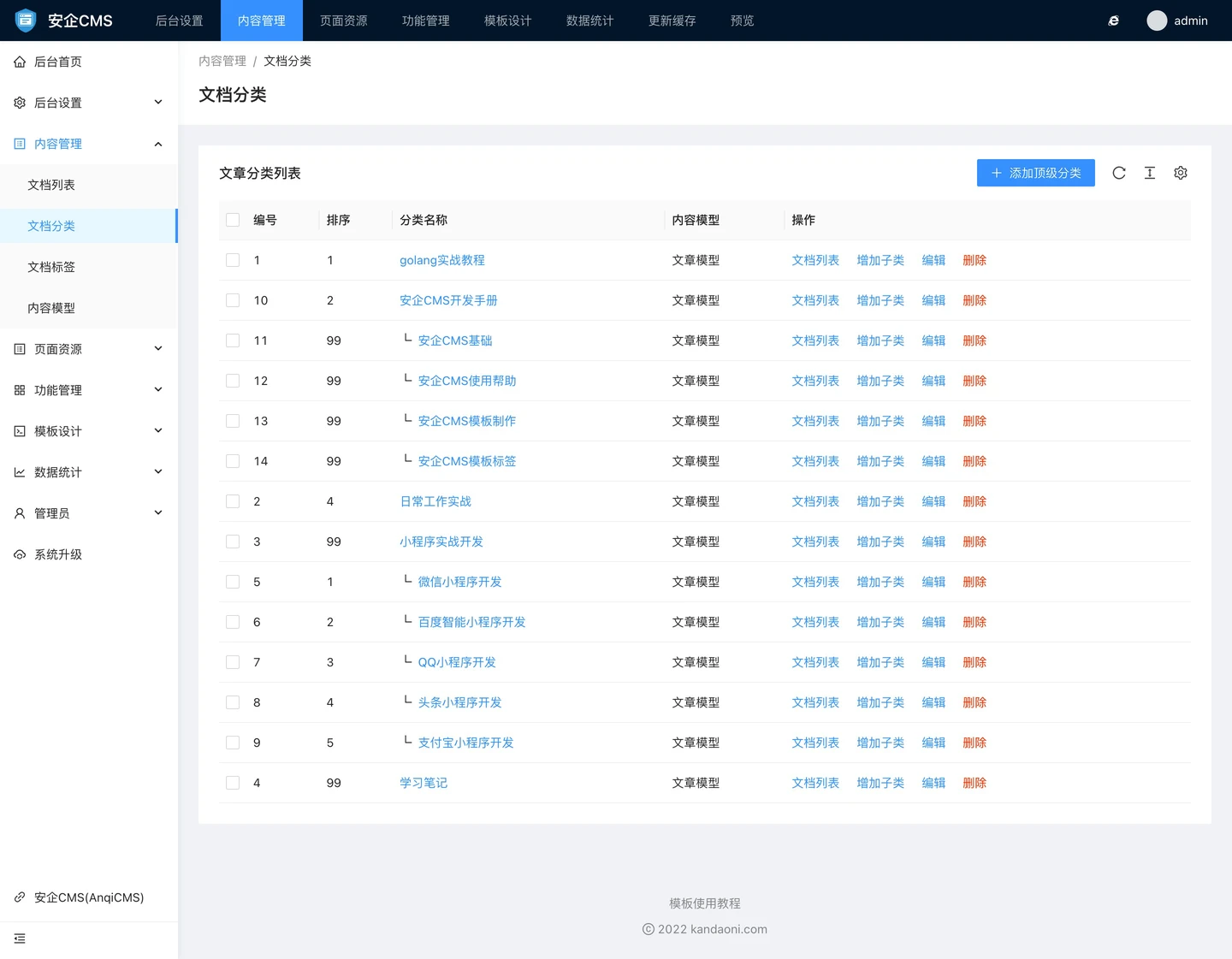
After a category is created, its content model is fixed and cannot be changed.
In the form for adding and editing document categories, the content you can enter includes:
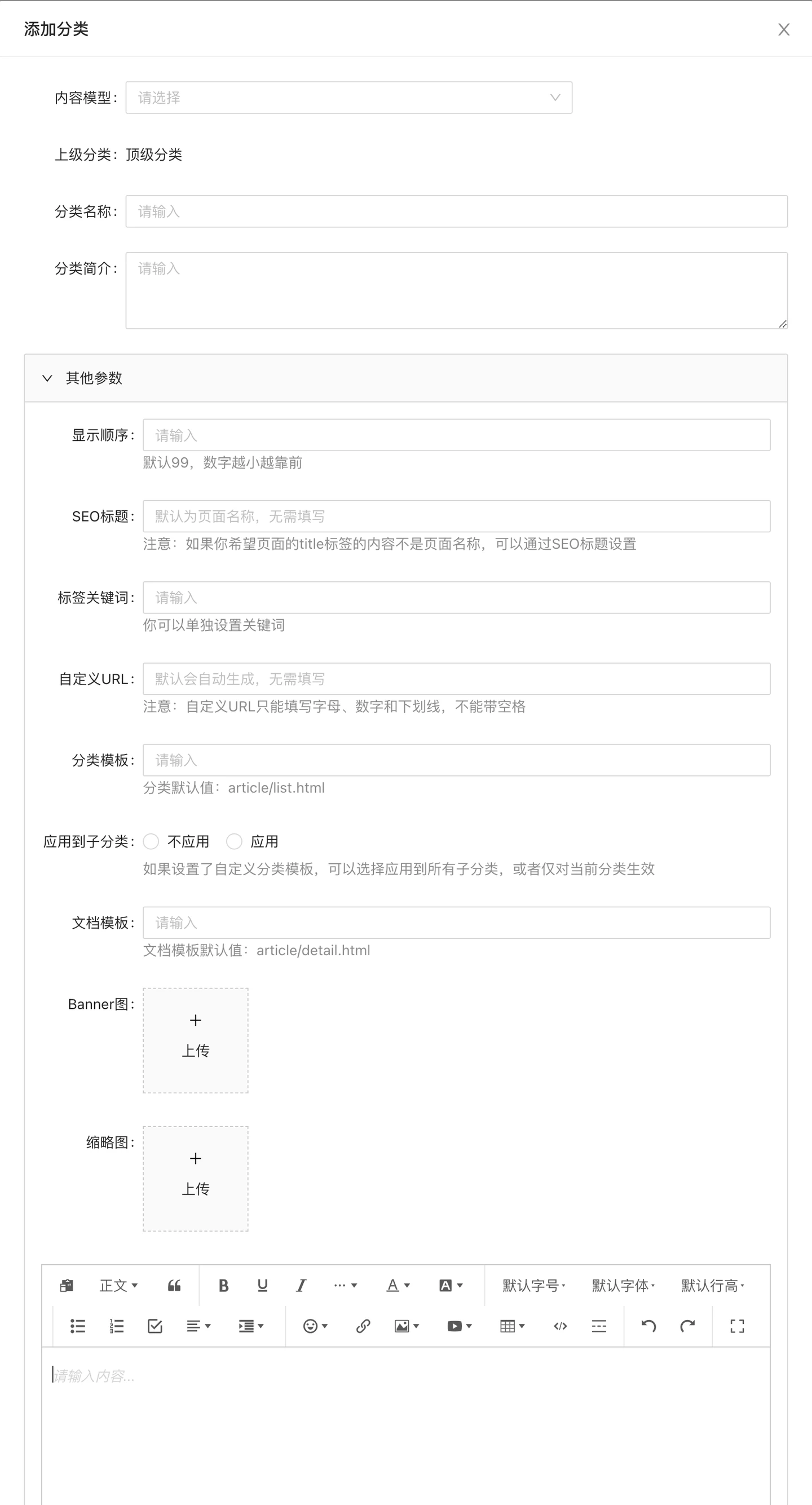
- Document model
- Once the document model is selected, it cannot be changed. The document model can only be selected when adding a top-level category.
- Parent category
- Only when adding a subcategory, you can select the parent category. Please select the same model as the parent category.
- Category Name
- The category name is the display name of the category on the front end.
- Category introduction
- The category introduction is the introduction of the category, and it is also the call content of the description tag in the tdk tag.
- .
- Some parameters include some less commonly used fields that are not necessarily required. You can set the content of these fields according to your actual needs.
- Display order
- The display order determines the sorting of this category, the smaller the number, the earlier it is displayed. The default value is 99 when created by default.
- SEO title
- The SEO title is used to display the title content to search engines. Note: If you want the title tag content of the page not to be the category name, you can set the SEO title.
- Keywords
- Category keywords can be manually entered. Separate multiple keywords with English commas, as this is more conducive to search engine indexing. You can also not set it.
- Custom URL
- The custom URL is used to call the pseudo-static rules enabled by the naming mode.Only when the custom URL takes effect under the naming mode of {filename} and {catname} in the website static rules.The default custom URL will be generated automatically according to the category name you enter.If you are not satisfied with the automatically generated content, you can set custom content by manual input.It should be noted that the custom URL must be unique, if it is not unique, the system will add random numbers to make it unique.
- category template
- You can set a custom template for categories, the default template is {category model}/list.html, you can set it to other template names as needed.Pay attention to ensure that the template exists in your template design package, otherwise it will cause this category to not open.If you have created a download.html template to display this category, then enter download.html here.
- Apply to subcategory
- The default category template does not inherit to subcategories, you can set it to inherit so that only, all subcategories under this category, will use the custom template you set.
- Document Template
- When you need to use a custom template for all documents in this category, you can fill in the name of the template you need to use here.Note that you must ensure that the template exists in your template design package, otherwise all documents under this category will not open.If you have created a detail.html template to display the document details for this category, then enter detail.html here.
- Banner image
- Some categories may require displaying some banner carousel images, you can set them here.You can upload multiple images. Note that you should use images of the same size when uploading.
- Thumbnail
- The category thumbnail is not required, it is only necessary to upload it when you need to call the category thumbnail on the front page.
- Category content
- The category content is not required, only when you need to call the category content on the front page, do you need to fill it in. The category content editor is rich in features and supports various text operations.