
Instructions for Adding Documents
📅 June 20, 2022
707
The document feature provides powerful operations for adding documents.By adding a document interface, we can add various types of attributes to the document, such as document title, recommended attributes, document classification, thumbnail, tag tags, and more.
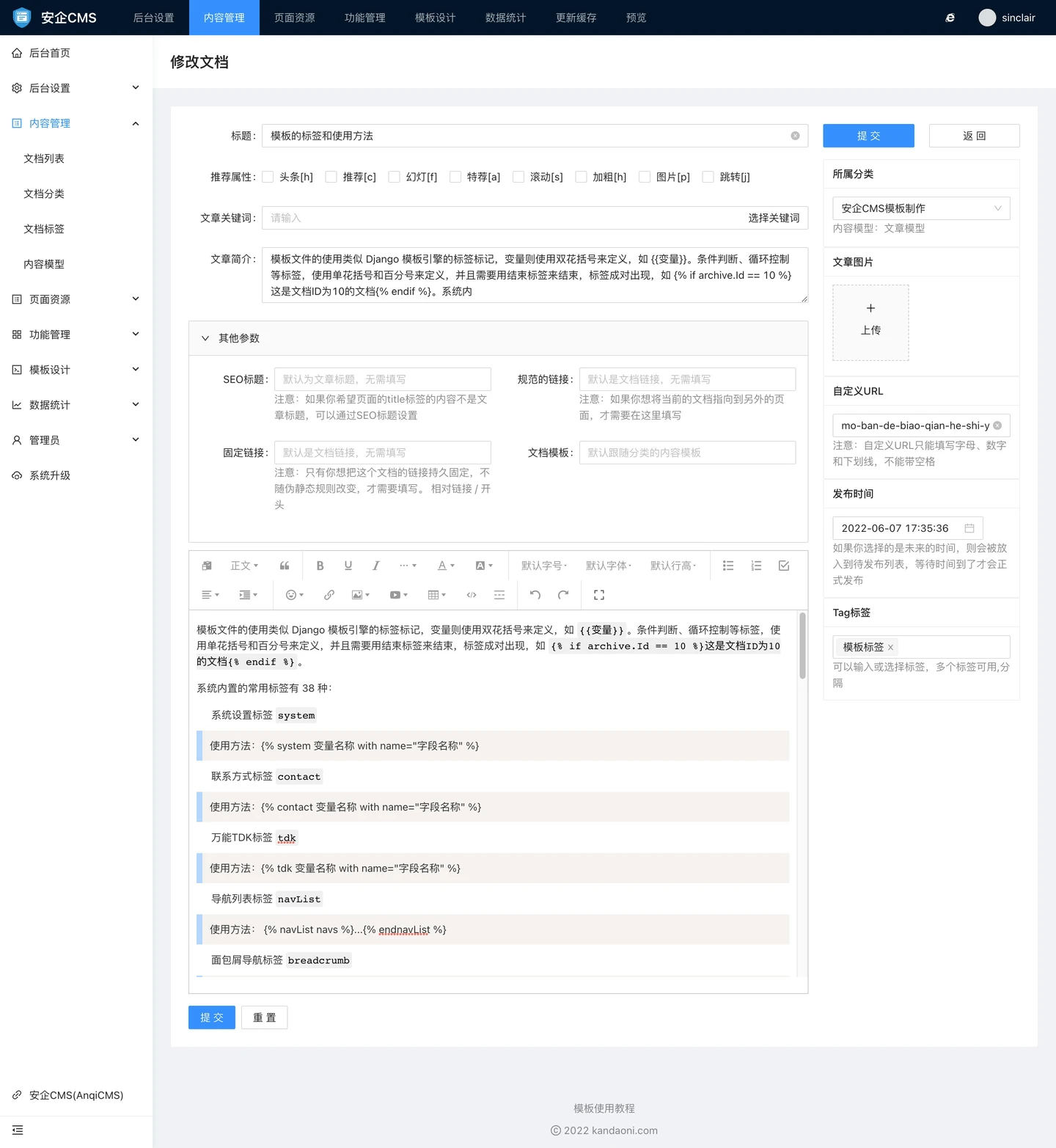
The default functions on the document addition interface include:
- Document title The document title is required and is used as the h1 title displayed to the user.
- The recommended properties of the recommendation document can specify 8 types of properties, which can be selected singly, in multiples, or not selected. After selection, the front-end template can call the specified recommended content through the specified property letter, flag="h".It should be noted that when calling from the front end, each list can only use one property to call.

The available tags are: 头条[h]/推荐[c]/幻灯[f]/特荐[a]/滚动[s]/加粗[h]/图片[p]/跳转[j].
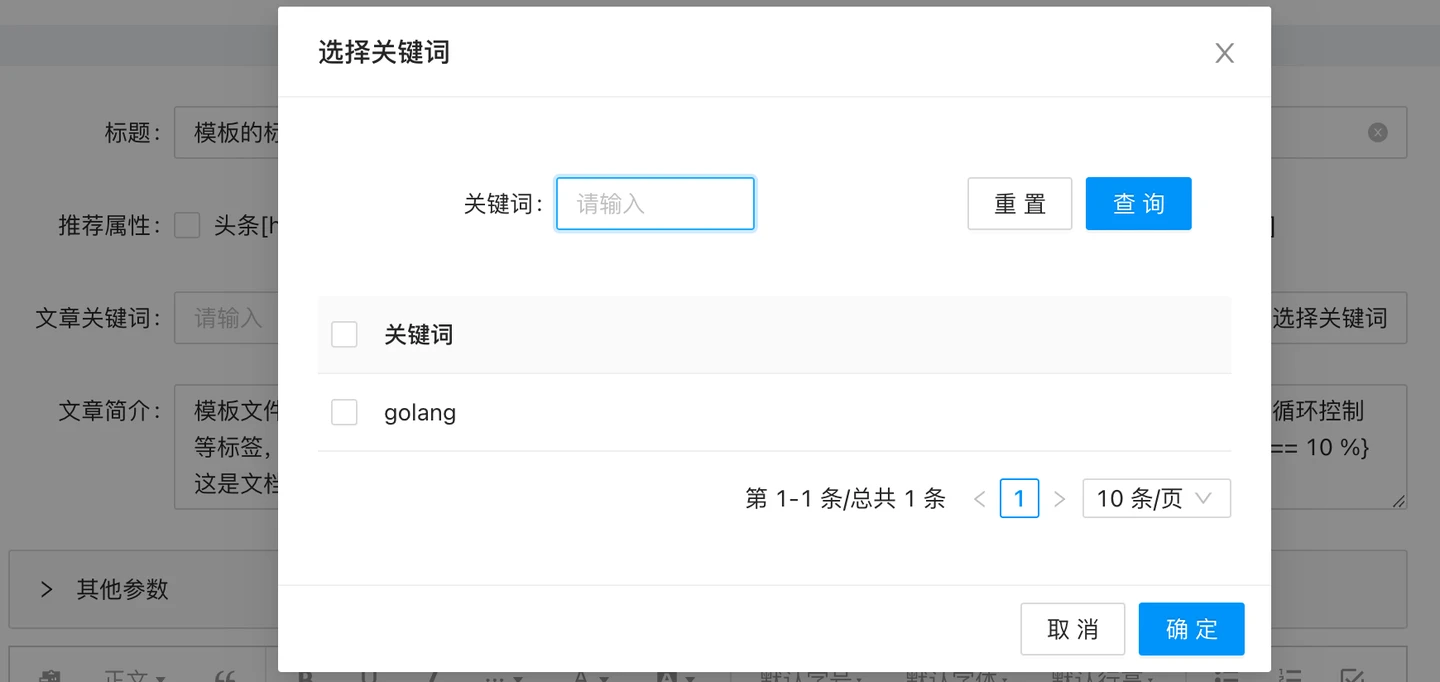
- Document keyword
Document keywords can be manually entered or selected by clicking the keyword button to choose keywords from the keyword library. Multiple keywords should be separated by English's,To distinguish, because this is more in line with the habits of search engine inclusion.
- Document Introduction
- A document summary is generally a brief introduction to an article. It is recommended that the document summary not exceed 150 words.When you do not fill in the document description, the system will automatically extract the first 150 characters of the document content as the document description.
- Document content
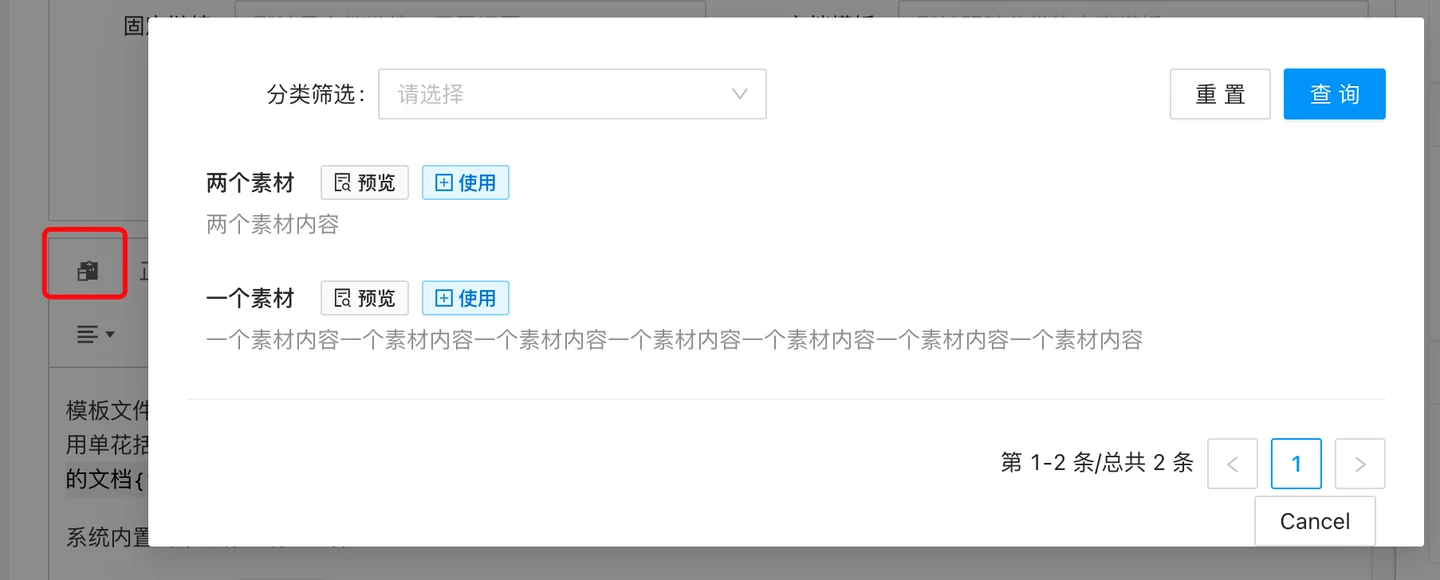
- Document content editor, providing rich content editing methods.Common editing buttons include: Set title/text, citation, bold, underline, italic, strikethrough, inline code, superscript, subscript, clear format, font color, background color, font size, line height, ordered list, unordered list, to-do list, alignment, indentation, emoji, link, image insertion, video insertion, table insertion, code insertion, horizontal rule insertion, undo/redo features.In addition to the commonly used edit button, it also supports using paragraph library materials, uploaded image resources, and so on.
- Category
Each document must be classified. All documents must be classified according to the type of model they belong to.
After selecting the category, you can display the model fields of the content model to provide input.For example, in this example, we selected the Anqi CMS template category, which belongs to the article model. At this time, we can fill in the other fields of the document model in other parameters.

- Document Image
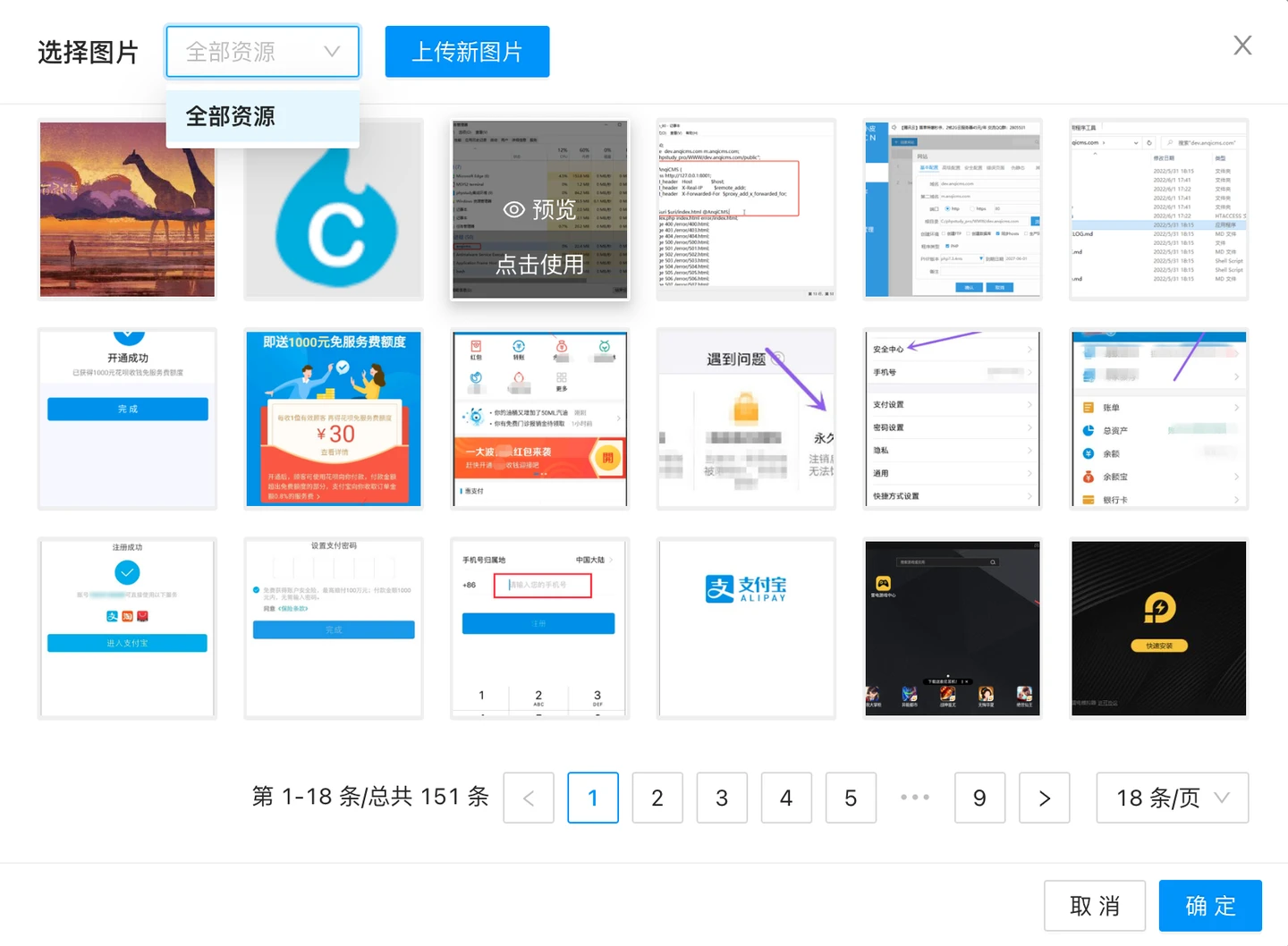
This refers to the document thumbnail. The document thumbnail can be selected from the image library or a new image can be uploaded.If you have not uploaded an image but the document content contains images, the system will automatically extract the first image in the document content as the document thumbnail image.
- Custom URL
- The custom URL is used to enable the pseudo-static rules for document naming patterns.Only when the website's pseudo-static rule uses the {filename} field naming mode, the custom URL will take effect.The default custom URL will automatically generate according to the title of the document you enter.If you are not satisfied with the automatically generated content, you can set custom content by manual input.It should be noted that the custom URL must ensure that it is unique across the entire site. If it is not unique, the system will add random numbers to it to ensure uniqueness.
- Release Time
- The default publish time is automatically generated, and it will be the current time at the time of publication.If you need your document to be automatically published at a future date, you can set the publication time to a future date, so the document will be officially published after reaching the specified publication time.The format of the publish time is: 2006-01-02 15:04:05
- Tag tag
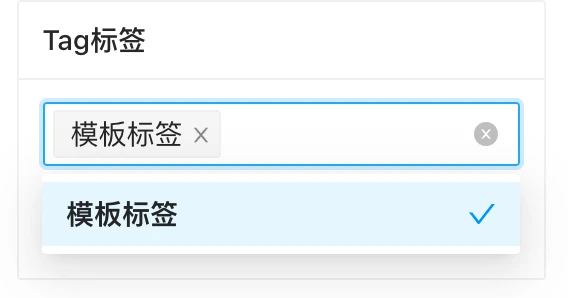
- You can add multiple tags to the document, tags are somewhat similar to topics, and can associate documents of the same type together in another way, other than classification.You can choose an existing tag or create a new one by entering it.When you enter the text of a new label, press Enter to convert it to a label.
- .
- For some less commonly used parameter fields, we have placed them in a separate foldable box of parameters. You can expand the foldable box to fill in more information for the document.
- SEO title
- The SEO title is used to display the title content to search engines. Note: If you want the content of the page's title tag to be different from the article title, you can set the SEO title.
- Standard link
- If you need to link the current document to another page, you should fill in here.The link should be called using the canonical tag in the template.This tag may be used on foreign trade websites. Please use a full link starting with http or https, such as: /article/98
- Fixed link
- Only if you want to permanently fix the link of this document, not changing with the pseudo-static rules, do you need to fill in. Relative link / starts with. Such as: /download
- Document Template
- When you need to specify an independent display template for a single document, you can fill in the name of the template you need to use here.Note that you must ensure that this template exists in your template design package, otherwise the document will not open.If you create a download.html template to display this document, then enter download.html in the document template input box of this document.
- More model custom fields
- When you customize more model-specific fields using the content model, they will also be displayed one by one in the collapse boxes of other parameters, and you can fill in the content according to your specific needs.
- If you define a field with a default value and you only want to display the default value, then you just need to leave it blank. When the system is called in the front-end, it will automatically assign the default value to the specified field.